
How to Personalize a Wedding Band Setlist
The single biggest way that you can personalize your wedding and make it feel like “you,” is through the music. Wondering how you can personalize a wedding band set list without it being a huge over-thinking complicated stress-inducing process? Well, the simple answer is to think about your story, your guests and the energy of the night.
Most couples start with the songs. Start with the moments instead. This is how it seems to work best. Songs are easier, but starting with the moments and building out is a stronger way to go.
When planning your music for your wedding, you have to think about each portion of the day and what you want it to feel like. Guest arrival, cocktail hour, dinner, first dance, dances with parents, opening up the dance floor, the dance floor in full force, winding down with the last song. Once you have an idea for each “mood” it’s easier to pick songs.
For example: cocktail hour calls for some stylish, up-tempo classics or modern covers that aren’t too loud and distracting, dinner calls for something that provides ambience but won’t distract from conversation, and the reception (after all the speeches and cutting the cake) calls for something that will get the party started and keep people dancing.
This is where the importance of elite live entertainment comes into play though. A great wedding band is going to know how to blend different decades and styles of music and how to read the crowd and gradually push them into a tailspin of excitement.
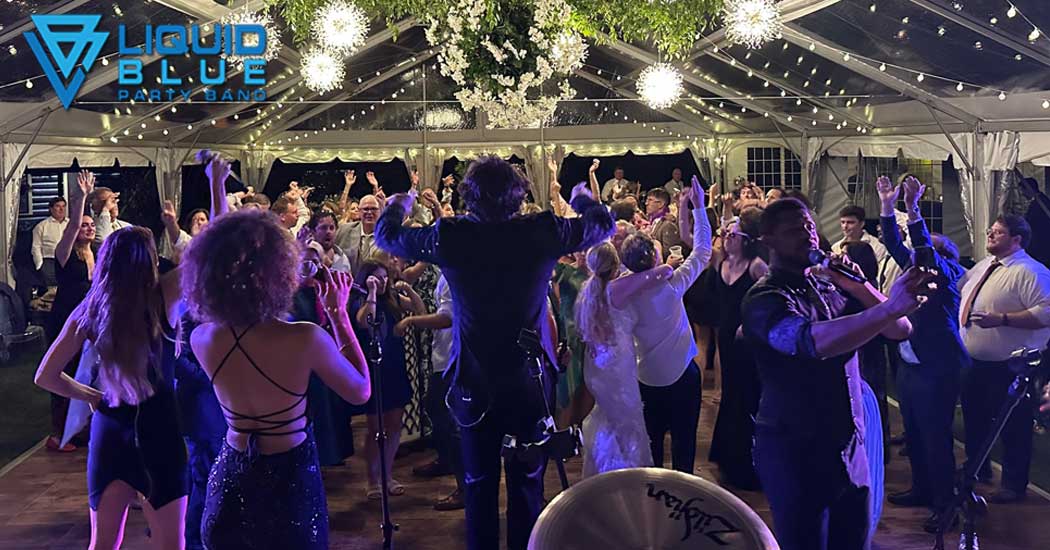
The right setlist tells an emotional story. It greets the guests, it builds excitement, it highlights the most important moments and it makes for an absolutely memorable reception. The setlist can be personalized to make it as individual as possible. A great live wedding band like Liquid Blue or Glitterati can do so much more than just play your favorite songs.

Start With Your Must-Play Songs, but Keep the List Tight
There are some important songs that every couple has. It could be the song you listened to on your first trip together, or the song you always ended your parties in college with, or a song that your family will request at all important family celebrations. Those are important to discuss.
But here’s the rub. A wedding band setlist suffers from too much control. You don’t want to give your band a long list of exact songs to play in an exact order because that takes away one of the biggest advantages of live music: the ability to adapt and change on the fly. Top bands typically don’t want to completely revamp their song list, they know what works and what doesn’t, so don’t make your reception a boring party by demanding edits in what would otherwise be an unforgettable night of dancing. Trying to micromanage a band’s song list often leads to the band deciding not to play for your event. If you’re a micromanager, you may be better off hiring a DJ.
The best solution is to have a few songs that are really important to you, and play them at the right time. Then allow your band to mould the rest of the set according to the reaction of the crowd. This will generally give the best result and mean that the set is personal, polished and dynamic.
Build the Setlist Around Your Guests, Not Just Your Favorites
This is the part that I feel many couples forget about. Your reception is your party, but making the guests engaged and involved in the party will make it incredible. Too many couples only think about themselves for this part and it’s about the guests, too.
If your taste runs indie, or deep cut country, or deep cut electronic tracks, then great, that represents you. But it might not get the floor packed. Learning to not let your taste destroy the dance floor is important. Doesn’t mean you have to completely dump it, but you have to be smart as to when you use it, and be extremely limited in your edits of a band’s song list.
Having a good acoustic song for dinner time, a trendy genre song as homage for cocktail hour, or a signature song late in the night is a great way to personalize your taste without inhibiting the general appeal of your dance music sets. The best DJs blend their own taste with a wide range.
This is the best approach for wedding music, especially when the wedding has guests of multiple generations. If you can build your band set in such a way that you can transition from Motown to 90s sing-a-longs to current hits to country favorites, you’ll keep everyone on the dance floor. This type of versatility comes naturally to experienced performers.
Use Your Wedding Style as a Music Filter
The songs you play should also match the vibe aesthetically as well as emotionally. A black tie ballroom reception, a chic beach/coastal destination wedding, and a modern ranch wedding may all be high energy, but the set list is going to be slightly different for each of those as well.
Match the Music to Your Wedding Style
- Black Tie/Ball Room: This would be your jazz standards, Motown, soul, swing, and nice pop music. I wouldn’t say all pop, but more of the elegant and beautiful pop music would be good here. I’d save the trashy pop for the line dance hall.
- Rustic/Ranch music: This genre covers country, folk, Americana and acoustic crossover pop stuff. I know that a lot of people aren’t fans of this genre, but many couples think that it’s good to have a variety in what you listen to.
- Coastal area/beach: Yacht rock, reggae-infused anything, tropical house, pop music that’s Feel Good (Beach Museum’s “Sunrise,” “Summer of ’69” by Bryan Adams, “Good Vibrations” by the Beach Boys, “Walking on Sunshine” by Katrina & the Waves, “Sunshine Superman” by Derek and the Dominos).
- Modern city stuff: Think R&B, funk, disco and modern dance floor fillers. (i.e. Anything from Marvin Gaye to today’s dance floor fillers).
- Cultural or multicultural songs: These are the songs that are traditional or popular in your family’s home culture or region, songs in two languages, etc. Some families have songs that are just a tradition to sing in their family, and that’s fine too.
A formal, fancy, expensive wedding usually calls for a more refined transition. Refined music during the ceremony, refined music during the cocktail hour, and a refined start to the dancing that will eventually transition into a party. A casual outdoor wedding tends to be more relaxed, and the music will be more crossover and familiar from the get-go.
This doesn’t mean that you can’t change lanes during the night. In fact, some of the best reception styles are ones that contrast. A very glamorous dinner course can lead into a very high-impact dance party portion of the night. This is much more exciting than just doing one style all night, but it has to be done intentionally.
Personalizing a Wedding Band Setlist – Choices for Key Dances
Remember that some songs are more important than others. The first dance, parent dances, and the grand entrance songs tend to be the more important ones emotionally for the wedding. You should spend extra time making sure you’re happy with these songs.
Key Moments Worth Hand-Picking
- Grand Entrance (1 song): This is a 1 song mix that’s used to let people know that the celebration is about to begin. This is usually a very recognizable song with a lot of energy. This is also a time where you can use a 1 or 2 minute version of a song to keep things short.
- First Dance (1 song): The first dance song is the most personal song of the night. Think about requesting the band arrange a custom cut of the song so that it only lasts 2-3 minutes. You want this song to be magical and not drag on.
- Parent Dances (1-2 songs): These can get really sentimental and are usually very sincere. Try to limit to about 2-3 minutes each, or make them do both dances in one song so that you keep the momentum going.
- Dance Floor Openers (2-4 songs): The first songs will be very recognizable songs that appeal to all ages. These are the songs that are going to get people off of their seats and onto the dance floor. You want these songs to be crowd pleasers and get the dance floor filled up quickly.
- Final Send-Off (1 song): This should be a song that everyone can sing to or a song that you really enjoyed and it’ll put you in a good mood for the rest of the night as you head home or to your next destination.
For your 1st dance, don’t pick a song that a lot of couples pick for their 1st dance. Pick a song that represents the two of you. Maybe it’s a classic, maybe it’s soulful, maybe it’s completely off the wall. If you have a song that you love, but you’re not a fan of for a live band, ask if the band would be willing to do a custom arrangement for you. Having a song edited shorter, starting slower, having a bigger ending, etc., can really make a song personal to you.
For parent dances, don’t over think this. If a traditional pick feels right, use it. If not, choose something that reflects your actual bond between you and them. A newer song, a classic from family road trips, or a tune tied to a shared memory can be more powerful than the expected standard.
For the entrances, think about energy. This is where you can really set the tone for the type of wedding you’re having. Some couples like big, rousing songs. Others might want something cool and funky. There isn’t a right or wrong choice, just what’s right for you!
Share Your Do-Not-Play List Clearly
Personalization is not only about what goes in. It’s also about what stays out.
Are there songs that you don’t like? Artists you don’t want to hear at your wedding? Let them know early on. A do not play list is just as important as your play list. Let them know if you have issues with certain over-played wedding songs, or certain genres of music that you just associate with bad memories, etc.
That being said, don’t make the list too long or you’ll put the band in a spot where they don’t know what to do. Saying no to a few songs is good. Saying no to half of the major dance songs in a band’s song list will hinder their ability to get the dance floor going. If you want to avoid cliché wedding songs, the best way is to find a band that knows how to bring a refreshed and elevated song list to the table.
Trust the Band to Read the Room
This is where experience is so important. It’s the sign of a lesser wedding band to follow a setlist like it’s scripture. A great wedding band understands that a setlist is more like a skeleton, which they dress out with meat and vegetables.
Even if the plan looks perfect on paper, the room may tell a different story. Sometimes people want soul and not pop. Sometimes your college friends just want to flood the dance floor playing 2000s throwbacks. Sometimes your families want to be up dancing all night to classic dance hits. Good bands can adapt and still keep the vibe of the event.
That’s the important part, especially during peak party time. What separates an okay reception from a fantastic one is the flow of the dance floor. It’s not just about what songs a band plays, it’s how they play them. A world-class band will know how to space out hits, when to play a certain genre, when to slow things down, etc.
Collaborate Early and Communicate the Big Picture
If you want the set list to feel custom, don’t wait until the last week to talk to them about it. You’re going to get the best results if the composer is involved with developing the songs from the beginning.
The best you can do is to let them know way in advance what songs are important to you, what the general vibe will be like, who will be there, and what you want the party to ultimately turn into from a cultural/family tradition standpoint. Let them know if you want a classy affair or a total blast, or even a classy affair that ends in a total blast.
This is also the time to talk about any specialty requests. Do you want a jazz trio sound for cocktails, and a powerhouse dance band sound for the reception? Do you need a country crossover band for part of the night? Do you have a song that you want them to learn that’s custom for your wedding? Working with a premium wedding band agency like Wedding Music Bands can help you find the right band to do all of these things at the highest level.
I think the best DJ’s (or anyone putting together a set list for a specific person) are the ones where it doesn’t seem like a lot of thought went into it, but every single song was carefully chosen for the purpose of making a person happy.
When you get this stuff right, people won’t talk about how great your music was. They will say how great the night was, how the dance floor was always packed, and how everything always sounded perfect for every moment of the night.
Frequently Asked Questions
How many songs should we give our wedding band?
Give them a list of songs you MUST have, and songs you want for certain moments (first dance, parent dances, entrance, last song). Aim for 3-5 must-haves, as well as a short list of songs they should absolutely NOT play. A typical band will play somewhere around 60-100 songs over the course of a 3-4 hr reception.
A luxury wedding band may blend multiple songs into medleys, which will keep the dance floor buzzing, while allowing them to play well over 100 songs – much more dance floor energy and guest satisfaction. Giving the band a song list of things you like will give them an idea of your taste in music without over-structuring the evening- you want them to be able to read the room and adjust accordingly.
How do we keep a mixed-age crowd happy without making the music feel random?
The secret is in how you run the dance floor. You start with the oldies that everyone of all ages love, like Motown, 70s funk, 80s pop to get the parents and grandparents happy. Then you let the band get into the party portion of the night, which would be the pop and hippie [hip-hop] and recent throwback for the younger generation. The key really is to have enough variety to make everyone happy.
When should we start collaborating with the band on our setlist?
Start the music conversation as soon as you book, but you should ask about music at the latest 2-3 months before the wedding. Send them a list of must haves, do not haves, and must-dance-to songs about 2-3 months (8-12 wks) in advance, and finalize it about 2-4 weeks before the wedding. If you want a live band to learn a custom song, they’ll need time to learn it and possibly charge you a fee for learning/new arrangements. They also need time to plan the flow of the night and make custom edits to songs.
